Another pointer to the impending winter is the October arrival of Fox Sparrows. At least five are around the area, paying regular visits to my seed carpet (which will one day attract a Harris's Sparrow). In lousy weather I took this short video. Any explanation why the sparrows continue to 'garden' for seeds when they are surrounded by several hundred thousand.
Saturday, October 25, 2008

Monday, October 20, 2008
Out with the old
The digital age means that there is little point keeping thousands of slides, especially as most of them are pretty awful anyway, so I decided to continue the process of copying them using a digital copying attachment for my Canon Rebel. I have worked my way through the Gambia slides so thought I would post a few here. I still have thousands to go from other trips so expect more poor to average images of things you cannot identify.
Gambia is one of the West Coast African countries which can be pretty much covered in two weeks. This we did in 2001, taking a package tour and getting a local guide. The trip worked out pretty well, lots of great birds, a very genial guide and most of the hoped for species seen.
On the down side I did manage to get one of the dysentries, I broke the golden rule and ate some tepid prawns in Marie-Salmonella sauce and ended up going home in a coma! For a bad flier its a great way to travel although the subsequent squitting through the eye of a needle for two weeks is not recommended.
Incidentally, I recommend the Senegambia Hotel as the place to stay in Gambia, the grounds are superb for birding with zero hassle (and they were not responsible for the Prawn Cocktail), the rooms are fine, the food good and the staff very friendly. It really is worth the extra cost.
Western Plantain-eater (below). A big obvious bird.

Wattled Plover with wattles

Gambia is one of the West Coast African countries which can be pretty much covered in two weeks. This we did in 2001, taking a package tour and getting a local guide. The trip worked out pretty well, lots of great birds, a very genial guide and most of the hoped for species seen.
On the down side I did manage to get one of the dysentries, I broke the golden rule and ate some tepid prawns in Marie-Salmonella sauce and ended up going home in a coma! For a bad flier its a great way to travel although the subsequent squitting through the eye of a needle for two weeks is not recommended.
Incidentally, I recommend the Senegambia Hotel as the place to stay in Gambia, the grounds are superb for birding with zero hassle (and they were not responsible for the Prawn Cocktail), the rooms are fine, the food good and the staff very friendly. It really is worth the extra cost.
Western Plantain-eater (below). A big obvious bird.


Wattled Plover with wattles

A White-crowned Robin-Chat which is actually more like a thrush.

Red-billed Hornbills, very common.

African Pygmy Kingfisher, perhaps a misnomer as I think they actually eat insects and fish, not pygmys.


Little Bee-eater, not very big.
Hooded Vulture. They feed these things daily with disgruntled guests (just kidding, they use noisy kids really), they will walk up to you and try to eat your shoes.

Yellow-crowned Gonolek, stunning looking bird.


Egyptian Plover, one of the must see World birds. We took a battered Mercedes 18 hours up river to the town of Basse to find this bird.

Bearded Barbet, its a barbet with the beard.

 Yellow-billed Shrike above, female Bufflehead below (the latter is not a Gambian species).

Hooded Vulture. They feed these things daily with disgruntled guests (just kidding, they use noisy kids really), they will walk up to you and try to eat your shoes.

Yellow-crowned Gonolek, stunning looking bird.


Egyptian Plover, one of the must see World birds. We took a battered Mercedes 18 hours up river to the town of Basse to find this bird.

Bearded Barbet, its a barbet with the beard.

 Yellow-billed Shrike above, female Bufflehead below (the latter is not a Gambian species).
Saturday, October 11, 2008
Autumn colour
I took the opportunity to spend an hour at the pits on Wednesday 8th October, the weather was fair and there were a few birds to enjoy.
Despite the dearth of shorebird habitat, the pits have continued to suprise and I added Baird's Sandpiper to the year list. Also there were three Pectoral Sandpipers, three Black-bellied Plovers and a Dunlin.
With the influx of geese comes the autumn cull by local shooters. Judging by the 15 or so corpses around the pits they are hitting and wounding more than in recent years, leaving them to die in their pits roost. I suppose I should be grateful that they don't shoot there and long may that continue. A few Snow Geese are also around but I did not see any casualties amongst them.
A opportunist Coyote was hanging around on the far shore of the pits, perhaps 600m away, hoping for a goose meal. I took a short video before he realised the attention he was attracting and reverted to being wily.
Moving on to the small wood by the sports complex car par, lots of American Robins were feasting on the berry crop while Yellow-rumped Warblers chipped from every bush. I had hoped to find a Winter Wren, I have them in the garden now and so there had to be a chance. As good fortune would have it I found a Brown Creeper instead, Pits tick 295.
Finally a pretty shot of the trees in the garden. Dark-eyed Juncos are definately in with perhaps 20 around, time to put the sparrow seed out.


Despite the dearth of shorebird habitat, the pits have continued to suprise and I added Baird's Sandpiper to the year list. Also there were three Pectoral Sandpipers, three Black-bellied Plovers and a Dunlin.
With the influx of geese comes the autumn cull by local shooters. Judging by the 15 or so corpses around the pits they are hitting and wounding more than in recent years, leaving them to die in their pits roost. I suppose I should be grateful that they don't shoot there and long may that continue. A few Snow Geese are also around but I did not see any casualties amongst them.
A opportunist Coyote was hanging around on the far shore of the pits, perhaps 600m away, hoping for a goose meal. I took a short video before he realised the attention he was attracting and reverted to being wily.
Moving on to the small wood by the sports complex car par, lots of American Robins were feasting on the berry crop while Yellow-rumped Warblers chipped from every bush. I had hoped to find a Winter Wren, I have them in the garden now and so there had to be a chance. As good fortune would have it I found a Brown Creeper instead, Pits tick 295.
Finally a pretty shot of the trees in the garden. Dark-eyed Juncos are definately in with perhaps 20 around, time to put the sparrow seed out.


Sunday, September 28, 2008
Late Bigby surge
A pretty dank weekend with rain spells and poor light. On the up side, Saturday delivered a nice mixed warbler flock to the front door although photographing anything was a challenge. An hour or so sat on the stoop (front porch) produced:
Orange-crowned Warbler (Garden tick)
Black-throated Blue Warbler
Chestnut-sided Warbler
Magnolia Warbler
Northern Parula
Nashville Warbler
Yellow-rumped Warbler
Blue-headed Vireo
Golden-crowned Kinglet (a plethora = more than 3)
Ruby-crowned Kinglet
Below a few photos including a three piece photofit for the Black-throated Blue Warbler, it just would not sit still.
Downy woodpecker
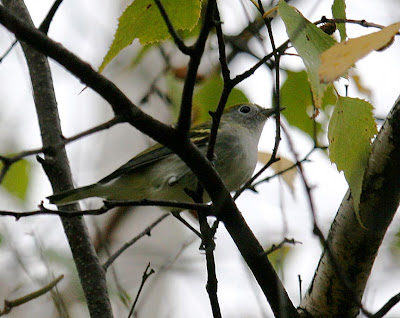
Orange-crowned Warbler (Garden tick)
Black-throated Blue Warbler
Chestnut-sided Warbler
Magnolia Warbler
Northern Parula
Nashville Warbler
Yellow-rumped Warbler
Blue-headed Vireo
Golden-crowned Kinglet (a plethora = more than 3)
Ruby-crowned Kinglet
Below a few photos including a three piece photofit for the Black-throated Blue Warbler, it just would not sit still.
Downy woodpecker


Chestnut-sided Warbler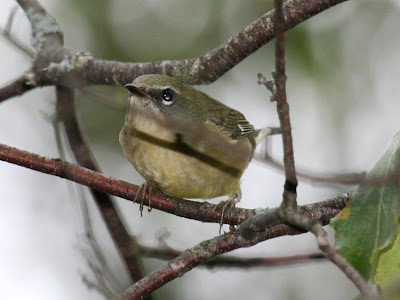
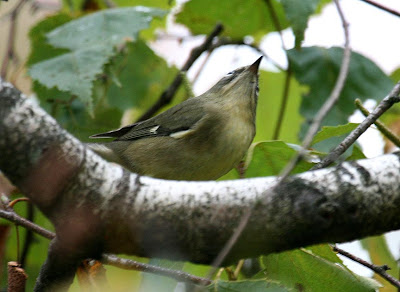


Put them all together and what have you got?
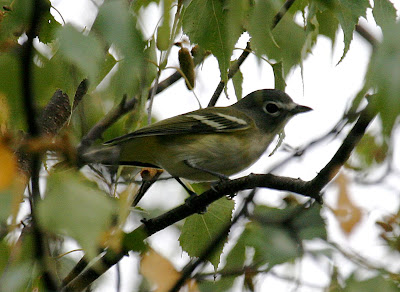


Blue-headed Vireo, it looked much nicer in real life than in these photos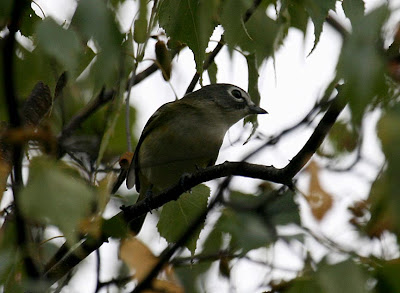


On Sunday it was pretty dark for most of the day but around 3pm the light got better, the clouds higher and a small passage of hawks slipped over the house. My standard hawk watching perch is on the back deck roof. The modest totals were:
Cooper's Hawk 7
Sharp-shinned Hawk 4
Peregrine Falcon 2
American Kestrel 3
Turkey Vulture 1
Monarch 2
Common Loon 1 (not a hawk!)
And while up there a Brown Creeper made the Bigby list.
Incidentally, if you are not sure what a Bigby is Google it, if you don't know what Google is, oh dear!
Tuesday, September 23, 2008
Slipping away
The leaves are rapidly turning and the morning chill heralds another Canadian winter around the corner. The birch trees around the house are a daily source of activity, a chickadee means a warbler and, as time is progressing, a warbler means a kinglet. The sky holds Canada Geese as they arrive for the autumn pause, pick up a bit of lead and then on further south to entertain others.
Another sign of autumn is that Canada is having yet another General Election where the competitors have all the appeal of lettuce and wet lettuce at that. This poor country does not appear to have a credible politician anywhere and its a pretty dead cert that, if a famous Hockey player were to stand for whatever party, they would get elected.
Back to the birds. The migration has been steady but not spectacular. As usual a few birds have appeared of interest but this province is pretty much the Cornwall of North America. I have concentrated locally on our immediate area and St-Lazare sand pits. The pits have had a few birds but shorebird habitat is at a premium although Dunlin, Short-biiled Dowitcher and a few Pectoral Sandpipers have popped in.
Below are a few snaps, nothing spectacular but I live in hope.
Hairy Woodpecker, Tennessee Warbler, Red-breasted Nuthatch, Golden-crowned Kinglet, Northern Parula, lurking Sharp-shinned Hawk, spectaculer wasp sp.


Saturday, September 13, 2008
Bad light but better birding
After a dismal spring migration it is good to see that the autumn is holding fast with tradition and providing some good local birding. Around Saddlebrook Bog, warblers are gathering, commuting garden to bog to garden with the roaming Black-capped Chickadees. By maintaining our garden feeders throughout the year, it guarantees that the local flocks (three at least) pass through the garden at some point, bringing their temporary guests with them.
This morning the first two hours after dawn and the late afternoon in the garden produced the following (in no particular systematic order and a list as much for European readers as anything):
Ovenbird (3)
Magnolia Warbler
Tennessee Warbler
Blackpoll Warbler
Nashvile Warbler
Yellow-rumped Warbler
Northern Parula
Black-throated Green Warbler
Pine Warbler
Red-eyed Vireo
Philadelphia Vireo
Ruby-crowned Kinglet
Chipping Sparrow
Great Crested Flycatcher
Eastern Phoebe
Scarlet Tanager
Hairy Woodpecker
Downy Woodpecker
Black-capped Chickadee
Blue Jay
Northern Flicker
American Robin
Sharp-shinned Hawk
Broad-winged Hawk
Red-shouldered Hawk
Below a few shots, mostly from today but including some shots of Hummingbird Hawk-moth, a species which has been subject to local discussion recently.

 Tennessee Warbler & Red-eyed Vireo

Blackpoll Warbler about to terminate a Cherry-faced Meadowhawk
This morning the first two hours after dawn and the late afternoon in the garden produced the following (in no particular systematic order and a list as much for European readers as anything):
Ovenbird (3)
Magnolia Warbler
Tennessee Warbler
Blackpoll Warbler
Nashvile Warbler
Yellow-rumped Warbler
Northern Parula
Black-throated Green Warbler
Pine Warbler
Red-eyed Vireo
Philadelphia Vireo
Ruby-crowned Kinglet
Chipping Sparrow
Great Crested Flycatcher
Eastern Phoebe
Scarlet Tanager
Hairy Woodpecker
Downy Woodpecker
Black-capped Chickadee
Blue Jay
Northern Flicker
American Robin
Sharp-shinned Hawk
Broad-winged Hawk
Red-shouldered Hawk
Below a few shots, mostly from today but including some shots of Hummingbird Hawk-moth, a species which has been subject to local discussion recently.

 Tennessee Warbler & Red-eyed Vireo
Yellow-bellied Sapsucker and an American Painted Lady butterfly.

 Hummingbird Hawk-moth.


Green Darner (below), very spectacular, click on the photo for the full effect.

A Broad-winged Hawk

 taking advantage of the brighter weather


 Hummingbird Hawk-moth.
Black-throated Green Warbler and lower down the page, Shadow Darner.


Green Darner (below), very spectacular, click on the photo for the full effect.

A Broad-winged Hawk


 taking advantage of the brighter weather
Blackpoll Warbler about to terminate a
 Cherry-faced Meadowhawk
Magnolia Warbler


Lance-tipped Darner. We really need a good dragonfly field guide here in North America!
Wednesday, August 20, 2008
Saddlebrook Bog
Near where I live is a small bog, Saddlebrook Bog. It is not very big but provides me with common passage migrants and the occasional surprise, such as a Prairie Warbler a few years ago, an Orchard Oriole nearby and fairly regular Orange-crowned Warblers.
The bog is slap bang in the middle of a housing development and under pressure from dollar greedy developers who would happily fill it in and build on it. The local council have some protection for it but its quality is likly to degrade with the news that the small woodland between it and a feeder lake will be taken out and built on, bye bye Ovenbirds, Red-shouldered Hawks etc etc.
Until it does end up the road it was designated to be, cynical I know but sadly realistic, it will continue to be attractive to birders and naturalists alike. The good news is that it has a shiny new boardwalk which will be open to the public soon hopefully. The fact that the public are already using it, and so are their dogs, means that it is now fair game so I joined the party.
It is well constructed and a pleasure to walk but I was a little surprised to find it cuts off the main drag at a right angle and plunges through the actual bog, ending in a previously unkown (to me) path into the soon to be lost wood. It certainly puts a new spin on conserving habitat by pushing paths through it, still, I have made a couple of sorties in the past few days, the results are below.


 The first fall warbler, an imm Magnolia.
The bog is slap bang in the middle of a housing development and under pressure from dollar greedy developers who would happily fill it in and build on it. The local council have some protection for it but its quality is likly to degrade with the news that the small woodland between it and a feeder lake will be taken out and built on, bye bye Ovenbirds, Red-shouldered Hawks etc etc.
Until it does end up the road it was designated to be, cynical I know but sadly realistic, it will continue to be attractive to birders and naturalists alike. The good news is that it has a shiny new boardwalk which will be open to the public soon hopefully. The fact that the public are already using it, and so are their dogs, means that it is now fair game so I joined the party.
It is well constructed and a pleasure to walk but I was a little surprised to find it cuts off the main drag at a right angle and plunges through the actual bog, ending in a previously unkown (to me) path into the soon to be lost wood. It certainly puts a new spin on conserving habitat by pushing paths through it, still, I have made a couple of sorties in the past few days, the results are below.


A few views.


Above a couple of the many Baltimore Orioles around the bog.

Great Spangled Fritillary, common in the area.
Below, one of a couple of female/imm Scarlet Tanagers present.


 The first fall warbler, an imm Magnolia.
Subscribe to:
Posts (Atom)
